
“Entrepreneurs usually don’t listen to people. Trust them to do their job. Remember, you invested with the understanding that the project was likely to fail.” Dave McClure
Even if conflicts do not lead to failure, they can impede progress. CB Insights survey of 110 Tech company failures ranks team and/or investor disharmony as number 10 on the causes of failure with 7% of the companies surveyed listing it as a cause of their failure. I have read articles that cite numbers as high as 65% of companies do not achieve all they can due to internal conflict. That seems high to me, but if you include times when investors force decisions on founders to adopt a course of action that later proves to be far from optimal, it may not be that wide of the mark. For a classic example of such a case listen to week 6’s case study “A pet peeve.” That will broadcast on February 13th and be available soon after on your favorite podcast provider. Please subscribe to my podcasts to ensure you do not miss it.
And according to Noam Wasserman’s book, “The Founder’s Dilemma”, business founders may face internal conflict. Do I want to be rich? Or do I want power? But more on that later in this episode.
Conflicts between co-founders can be particularly damaging to a company let’s consider them first. Such conflicts can occur even when the cofounders are close friends”. But you can take steps to mitigate the risk by carefully choosing your cofounder.
Choose someone who has a complementary temperament. I attribute a highly successful business turnaround I achieved, to the fact that my number two kept me in check. I am a big-picture guy who can sometimes be a little too hasty. My number two was a detail guy, and he would question my plans. Asking did you consider this? Have you thought about that? Between us, we developed action plans that took a loss-making business to an acceptable ROI in about 18 months.
Select someone with different operational skills. I am a finance guy so bringing another finance person to the party will not add much. Sales and marketing are my weaknesses. What are your weaknesses? It may seem obvious, but if you have a great idea for a new approach to a traditional industry in which you have no experience; find someone with that industry knowledge. This may seem obvious, but it is not always acted upon.

Similar work habits. If you are planning to work 996, a term often used by Chinese entrepreneurs to mean working from 9:00 AM to 9:00 PM six days a week, you will not be happy working with someone who has a different view on work-life balance.
This does not mean you have to work the same hours, but you should have the same level of commitment. As Sahil Lavingia puts it, being an entrepreneur means you work sixty hours a week, so you do not need to work forty hours a week.
Alignment of roles. Most entrepreneurs want to be the CEO of the business. Joint CEOs are not a good idea. If you decide every decision has to be a joint decision you will slow down progress. Agree on the role each of you will play. Define the rules for when each co-founder will have the autonomy to make decisions and when they should discuss decisions with the other co-founders. Self-sufficiency is an important attribute but there must be limitations. Especially in the early stages when cash may be limited.
Likeability and Trust. It is essential that your cofounder should be someone you like and enjoy working with. It is often said that people would prefer to work with a likable but mediocre performer than a competent jerk. I am not suggesting you hire mediocre performers but certainly stay away from the expert who you dislike. It goes without saying that trust and honesty are tickets to play. A word of caution until you have worked together under extreme stress, you really do not know your co-founder’s true colors. In the case study “They did not cotton on” we will learn how two close friends who swore that business would never get in the way of their friendship, fell out when the decision of whether to continue or to fold the business became critical.
Same vision. Ensure you and your co-founder have the same end goal in mind. Suppose your plan is to grow the business organically and work in your company until you retire, and your founder’s idea is to flip the business as soon as possible. If that case, it is not going to be a happy relationship. An extreme example I know, but you get the point.

The mindsets, values, and expectations of investors and founders can be profoundly different. The alignment of values is the most important factor for the relationship to grow in the right direction – short-term vs long-term thinking, straightforward vs “behind the back” board politics, active help vs blame distribution. When there is a misalignment in the values, it manifests very soon and leads to headaches for both the founder and the investor.
Therefore the first step when entering the founder-investor relationship is to align your values and set up the right expectations, communication, and working process. The second step is the alignment of the risks and the opportunities from both the founder and the investor’s perspective.
For investors, it is important to remind themselves constantly that the founder is the star of the show. It all begins and ends with the entrepreneur and his/her vision. Unfortunately, many times we see the opposite – investors decide to act like entrepreneurs and as if they are the ones leading the game. Then they try to impose their vision on the founders and tell them what to do, expecting for them to execute. Because the investors have given them funding and have some rights, doesn’t change the fact that the founders are the ones leading and building the company and investors are fully dependent on them. Partners shouldn’t misuse their rights.
One unwanted characteristic to look out for in an investor is that they either clap when everything is going well, or ignore and criticize the founder when things become messy or the numbers don’t meet expectations. Unfortunately, many investors choose the more convenient and easier way to go and are not there to prepare the founders for the moments when things get tough. They are not there when they are truly needed. So look for active investors and not “wine and dine” heroes.
Nurturing a meaningful founder-partner relationship takes time, commitment from both sides, honesty, and integrity. It sounds complex, but once you have the correct attitude and commitment from both the entrepreneur and the VC, the journey of building a great company will be much more enjoyable.
There has been a lot written about managing team conflicts and it is too big a topic to cover on this week’s show. While doing my research for this episode I found a useful series of articles from Lighter Capital. To access those articles Ctrl+Click here.
When it comes to resolving any conflict clear and honest communication is key. But when it comes to critical conversations most folks either avoid the conversation completely or handle it badly.
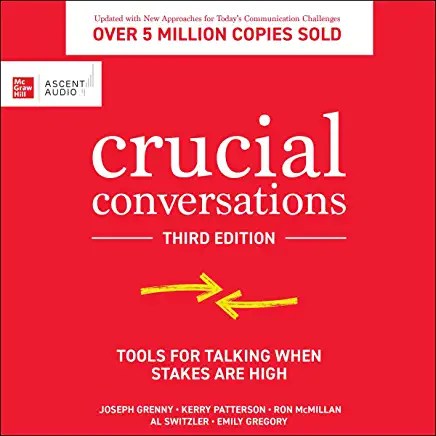
A book that I have turned to over the years is “Crucial Conversations Tools for talking when the stakes are high” By Joseph Grenny and four others. It’s sold over 5 million copies so it must be doing something right.
Here is a link to the book on Amazon.
Last year I made a presentation on this topic to an executive peer group based on the learnings from the book. If you would like a PDF of the bullet points from that presentation, please do not hesitate to contact me. There is never a bad time for a bit of honest self-assessment. Find some time to consider your own communication skills. As an introvert, I find open conversations difficult, and it takes me some time to find the courage to start such a conversation. But when I do I find, more often than not, that they go well and the outcome is beneficial for both sides. Now is the time to improve your communication skills, you can start with your own family. Remember forewarned is forearmed.
 Why Start-Ups fail