
CB Insights survey of 110 tech firms that failed ranked mistiming your product launch as the eighth leading cause of a start-up failure. 10% of business owners attributed their business failure to this cause.
Mistiming your product launch can be subdivided into three categories. 1) You launch your product too early; this is probably the most common reason for mistimed product failure. 2) You launch your product too late, and a competitor gets a head start. Or 3) the market is not yet ready for your product. There have been several recent examples of this in the augmented/virtual reality field.

Let’s start by looking at examples of products that market leaders launched too early. It’s not just start-ups who make this mistake some major corporations are guilty of this error.
In the time before smartphones, there were PDAs, (Personal Digital Assistants). Apple created The Newton Message Pad. It was able to do basic word processing, store contacts, and send faxes. It also was compatible with a stylus. Launched in 1993, it was heralded as being revolutionary. Due to the technology available at the time, the Newton was quite bulky, not a device that would easily fit into your pocket. The handwriting recognition technology did not meet customer expectations. “The Newton” did not live up to marketing promises and was eclipsed by the much more capable iPhone.
Ex-Apple CEO, John Scully said, “Miniaturisation, digital cell phones, the web, and cheap solid-state storage had not yet happened. We had the right idea but didn’t have Steve’s talent to create a culture-changing product.
Microsoft’s SPOT Smart Watch, launched in 2004, was a product that was much too early. It was part of a suite of products marketed as Smart Personal Objects Technology, (hence SPOT) products that could send and receive data through an FM-based protocol called MSN Direct. The watch could display helpful information such as traffic alerts and the weather; it could check stocks, sports scores, and calendars. It could also display instant messages. The watch was discontinued four years after its launch due to limited demand, possibly due to its lack of WiFi compatibility. Seven years later, the Apple Watch was launched.
There is a strong temptation for a start-up to launch early. There is only so much money available; the start-up’s runway is limited.
Reid Hoffman, a co-founder of LinkedIn, is often quoted as saying “If you are not embarrassed by the first version of your product, you’ve launched too late.”

But there are good reasons not to launch too soon. A product that falls short of promises will quickly get savaged on social media and in the press. That loss of reputation can be irreparable and you may not get a second chance. Software and cloud-based products are particularly vulnerable to this problem. By their very nature, such products give their creators the potential to apply fixes and updates after the products are out in the market. Because of this, the product is launched with a “we can fix that later” mindset.
You can avoid making this mistake by using a checklist that ensures your product is launch-ready.

- Be sure there are no known issues with your product. Or at least no known issues that will significantly impact your customer’s user experience. It would be better to remove features that are not yet ready and launch a stripped-down version of your product. You could use this as a minimum viable product to get customer feedback.
- Your product is better than your nearest competitor’s product. The media will quickly size up how your product compares with other available offerings. You can be ready by detailing what is new and different about your product. This should be a self-check, be honest in your comparison with similar products. Ask does our product bring something to our potential customer she cannot find elsewhere.
- Your product does what you say it does. Be passionate about your product. Talk about it; do not be distracted into discussing your future vision. What you plan to do in the future can capture the media’s attention, so they lose focus on the product being launched. Keep their attention on the product that exists, not one that may, or may not, be available down the road.
- You can demonstrate the product in action. You should have enough current users to validate that the product works in the real world. These will likely be development partners who have agreed to test your product in their organizations. They may work with you to obtain the software at a reduced price. Or if your product confers a competitive advantage beta customers will be willing to work with you to get a leg up on their competition.
- Do not launch a product just to be first in the marketplace. There is a first-mover advantage but, only if the product does what is claimed. If it does not deliver, the second mover who launches a working product will claim the advantage.
For an example of a product that was launched too late, or not all, we can turn to Sony.
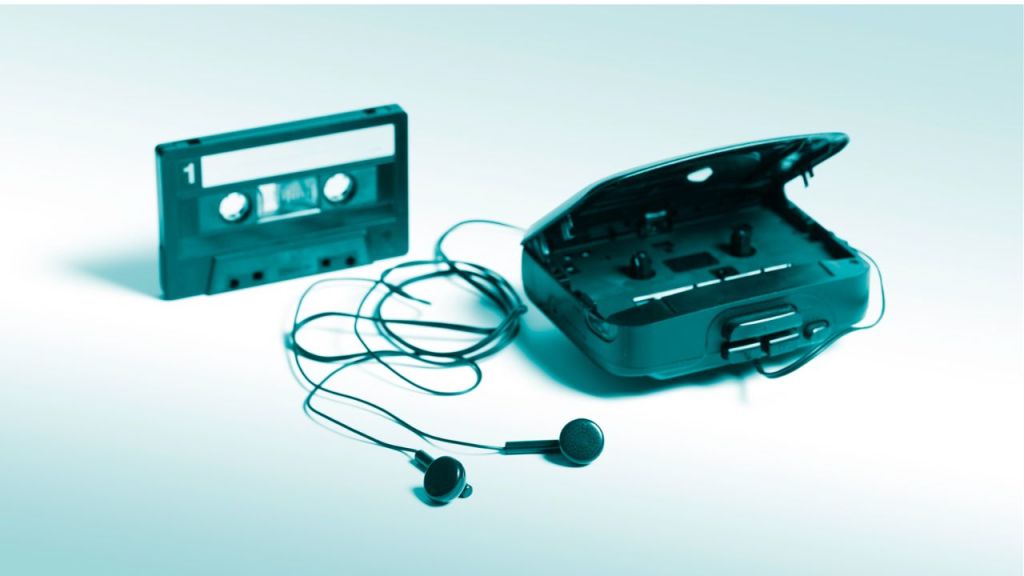
Sony changed the way we listen to music when they launched their Walkman cassette player. Later Sony had the technology to launch a better product than the iPod, but it never happened.
The company was too afraid to test out something new, thinking it would threaten their position in the market. The lack of courage to disrupt your own market with a new technology can bring down the largest of companies. Think of Kodak who invented the digital camera but did not capitalize on their potential first-mover advantage. Hindsight is 20/20 and Kodak is often criticized for its lack of vision. But consider the disruption they faced. Their business model of selling film was a repeat purchase model. Folks would make a one-off purchase of a camera and then buy a film on a regular basis. Switching to digital, people would buy a camera once and never need to buy film again. It takes a certain amount of courage to disrupt your own business model. But if you do not do it, someone else will. Of course, Kodak did go on to sell digital cameras, but it was outcompeted by superior technologies available from its rivals.
Your product is ahead of its time. I argue that this was the case for the Segway. It was certainly overhyped. The inventor Dean Kamen said his upcoming invention was nothing less than a replacement for the automobile and that it would change the way people moved around cities. It would transform our lives.
When it turned out to be a motorized scooter with a hefty $5,000 price tag, to say the press and public were disappointed is an understatement.

If launched today with the advances in battery technology and electric motors combined with a much greater acceptance of bike lanes and green commuting, the Segway may have found much greater acceptance by the general public.
Vreal planned to build a virtual reality space for game streamers to hang out with their audience. A concept that enabled them to raise $12 million in 2018. However, the available hardware and bandwidth did not evolve as the company had expected. Although the company delivered on its promise, the user base was much smaller than expected. In a press release, Vreal said “Unfortunately the VR market never developed as quickly as we all had hoped, and we were definitely ahead of our time. As a result, Vreal is shutting down operations, and our wonderful team members are moving on to other opportunities”
Timing your product launch is one of many challenges faced by an entrepreneur. You do not want to wait forever, making changes in hopes of perfection. Equally, you should not launch a product that falls short of its claims. We can learn a salutatory lesson from Microsoft, which launched Windows Vista with considerable fanfare in 2007. The public and press had high expectations for Vista as did Microsoft. They predicted that 50% of users would run the premium edition within two years. But the software has so many compatibility and performance issues that even the most loyal Microsoft customer lost faith. It was so bad that Apple lampooned it in an ad campaign. Microsoft being a huge corporation was able to weather the storm. As a startup, such a failure could mean the end of your business. Avoid this mistake using the five-point checklist I covered earlier in this post.
 Why Start-Ups fail